
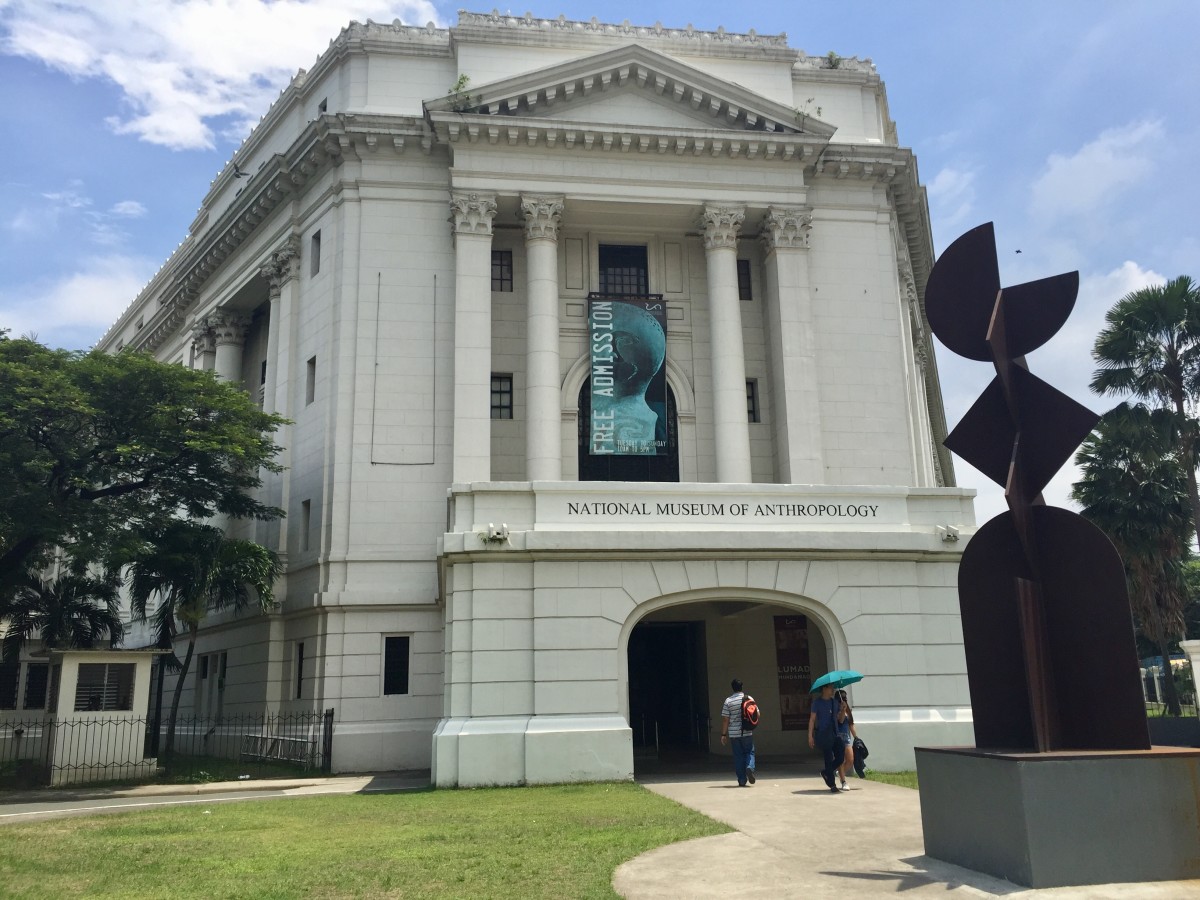

The husband and I were recently in the haven of “touristy” spots in Manila and, done with our “to-dos” a little earlier than expected, figured, why not go on a date and be a local tourist for a few hours? To deviate from our usual movie and dinner dates, we checked the map for museums near our location. We had a couple of museums in mind and finally decided to visit the Manila Museum of Anthropology.
“This post may contain affiliate links, which means I receive a small commission, at no extra cost to you, if you make a purchase through a link.”

How to Get to the National Museum of Anthropology
The National Museum of Anthropology is located at Padre Burgos Ave, Ermita in Metro Manila. It is less than half a kilometer from the Rizal Park, the most popular park and landmark in Manila. Thousands of “jeepneys”, buses, and taxi cabs pass through Taft Avenue daily, a major thoroughfare just a few steps away from the museum. You can also get here through the nearest train station, the United Nations’ LRT station, which is also a little less than half a kilometer away.

Click here for Directions to the National Museum of Anthropology

Women Travel Make Up Organizer
National Museum of Anthropology: Schedules, Fees, and Dress Code
The museum is open from Tuesday to Sunday, 9 AM to 6 PM (last entry is 5:30 PM), and you don’t need to pay an entrance fee; you can explore it during its open hours for free. There is no strict dress code, but smart casual or modest attire is encouraged. Bring your ID for registration.

Upon Entry
At the entrance, the guard asked us to place our belongings through a security x-ray machine. We then went to the reception section to log our names and other information. We were then instructed to take our valuables and leave the rest at one of their lockers. The receptionist also reminded us that we can only take photos without flash and not take videos.
The Levels of the National Museum of Anthropology
The National Museum of Anthropology is a component museum of the National Museum of the Philippines, exhibiting the anthropology and archaeology divisions. The ground floor houses the various offices of the museum, while the showrooms and exhibits start from the second floor up to the fifth floor. During our visit, we were able to explore the second to the fourth floor as the fifth floor was, at that time, closed to the public.
The Galleries and Exhibits
There were three to five galleries per floor. We explored the galleries below.
Garing: The Philippines at the Crossroads of the Ivory Trade
The first gallery we got into was Garing: The Philippines at the Crossroads of Ivory Trade. It showed some ancient and fossilized sources of ivory illustrating the history, timeline, and development of the ivory trade in the Philippines.


The San Diego: 500 Years of Maritime Trade
A few turns from the first exhibit, there is a showroom all about a war vessel called San Diego. Specifically, it features pieces from the demised Spanish vessel, including hundreds of ancient jars where the soldiers stored their water and food supply. In addition, it showcases everyday items like lamps, plates, and bowls, as well as personal belongings of the passengers, such as golden belts and jewelry. Furthermore, the display spans various weapons, ranging from knives to swords, and from small pistols to cannons.


800ML-1500ML Water Bottle Carrier Bag


Of War and Peace
This exhibit featured weapons, mostly cannons, situated along the museum corridors.

Manlilikha ng Bayan Hall (National Living Treasure)
This gallery on the third floor highlights Filipino artists in recent years. It featured the likes of Darhata Sawabi, Uwang Ahadas, Alonzo Saclag, and Lang Dulay. It included musicians, storytellers, dancers, painters, seamstresses, textile weavers, and other artists in different fields.

Faith, Tradition and Place: Bangsamoro Art from the National Ethnographic Collection
This exhibit presented how creative and artistic the Bangsamoro art is. It showed a sample of their colorful everyday clothing and hats, shields, and “bolos”, and their unique baskets and other containers made of native materials. It also showcased how good they are at carving wood.


Travel Mommy Multifunctional Diaper/Food Storage Backpack


“Kaban ng Lahi” (Archaeological Treasures)
On the third floor is a gallery displaying ancient burial pieces, mostly prehistoric anthropomorphic jars sculpted to represent humans. The artifacts were located in Saranggani Province.

Read: Review: SM East Ortigas Director’s Club Cinema
Biodiversity and Rice: Climate Change
This was one of the last galleries we visited, featuring various species of rice, jars, rakes, and other tools used in rice farming. Furthermore, it included ancient statues used to scare birds and numerous species of snails and birds detrimental to rice farming.


“Hibla ng Lahing Filipino:” The Artistry of Philippine Textiles
This gallery featured a variety of textiles and wooden weaving machines. Additionally, it also presented the evolution of textiles in the country and the creativity of woven cloths with different designs.


“Baybayin:” Traditional Scripts of the Philippines in the National Museum of Anthropology
One of the galleries that ignited joy, and where the hubby and I stayed the longest, is all about the Filipinos’ ancient script, Baybayin. The room was filled with exciting objects that illustrate the progression of how Baybayin was engraved and presented through time. In particular, it featured an engraved stone evolving to a copper plate, moving from old transcripts to a modern t-shirt, and then to photos of script tattoos, culminating in a blown-up copy of a one-hundred-peso bill where the script was featured.


BUY 1 TAKE 1 600ML Foldable Water Bottle


Entwined Spheres: Mats and Baskets as Containers, Costumes and Conveyors
This room was filled with various pieces made of baskets and woven mats in different sizes and materials.


My Rating: National Museum of Anthropology in Manila
The National Museum of Anthropology in Manila is truly remarkable. It’s a vast museum where every space feels purposefully designed to showcase history to its fullest. Furthermore, encountering our past through such richly presented historical objects was utterly mind-blowing. A definite must-visit for any museum enthusiast.


This article was originally published on November 25, 2019, and updated on January 25, 2026.


Leave a Reply